Research with sources kept in view
A personal prototype for a locally-running, all-in-one research app
Papyrus is an experimental desktop application for reading sources, organizing evidence, and exploring connections across documents. It is being developed as a personal project shaped by concerns about research privacy, unnecessary computation, and tools that can obscure or displace a researcher’s own judgment. All tools, including Generative AI tools, are designed to remain on the researcher’s computer.
While the project does include generative AI, it is but one tool among several. Conventional parsers and rules handle suitable repeatable tasks; smaller task-specific models can assist with narrow classifications or retrieval; and a locally run generative model can be used selectively for synthesis and other judgment-heavy steps. Results still require review, and all generated content is explicitly marked as such. Local execution supports privacy and control, but it does not eliminate electricity use, upstream training impacts, error, or bias, though the app takes several measures to mitigate many risks traditionally associated with Large Language Models. Use of GenAI in Papyrus is also optional, no models or backends come shipped with the app (but can be installed through it) and all features that don't require GenAI work without any models installed.
Three priorities
Privacy and local control
Project files, extracted records, indexes, and configured models are intended to stay on the researcher’s machine during processing. Network-capable actions are limited solely to plugins and have an explicit boundary rather than silently sending research material elsewhere.
Resource-conscious processing
Papyrus separates tasks so parsing, indexing, rules, caching, and smaller models are used before a generative model is considered. This is a design goal motivated partly by environmental concerns; comparative energy, water, or emissions benefits have not been measured.
Researcher judgment and transparency
Annotations, source links, prompting traces, and reviewable model context are intended to keep evidence and interpretation connected. These mechanisms help inspection; they do not reveal a model’s internal reasoning or guarantee correctness. The app marks all generated content, and contains links to the exact sections Generative AI models used in completing responses, so researchers can verify any generated content for themselves.
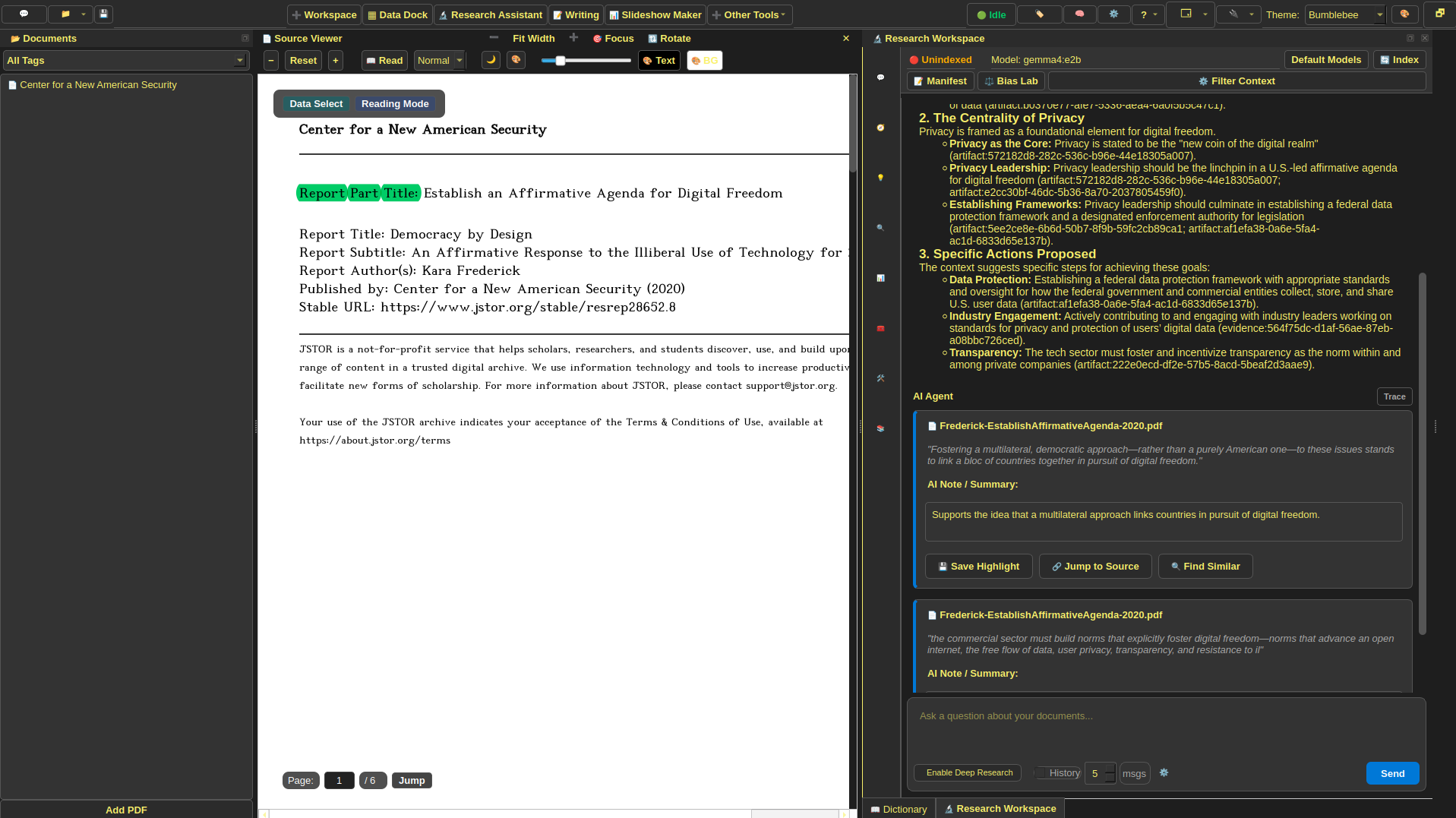
A four-stage research workflow
The prototype is designed to integrate machine learning and generative AI tools into a normal research workflow rather than fully automate the process. Processing begins when material is added, but reading and interpretation remain the researcher’s work.
- Collect and read sourcesAdd supported documents or media and work with them in built-in viewers. Import can parse text, divide it into addressable passages, extract selected records, and prepare search indexes. Deterministic (non-AI) algorithms also extract entities such as people, dates, citations, and organizations from sources so researchers can quickly find people, dates, and organizations that are prevalent across sources, as well as any works commonly cited by papers they're relying on
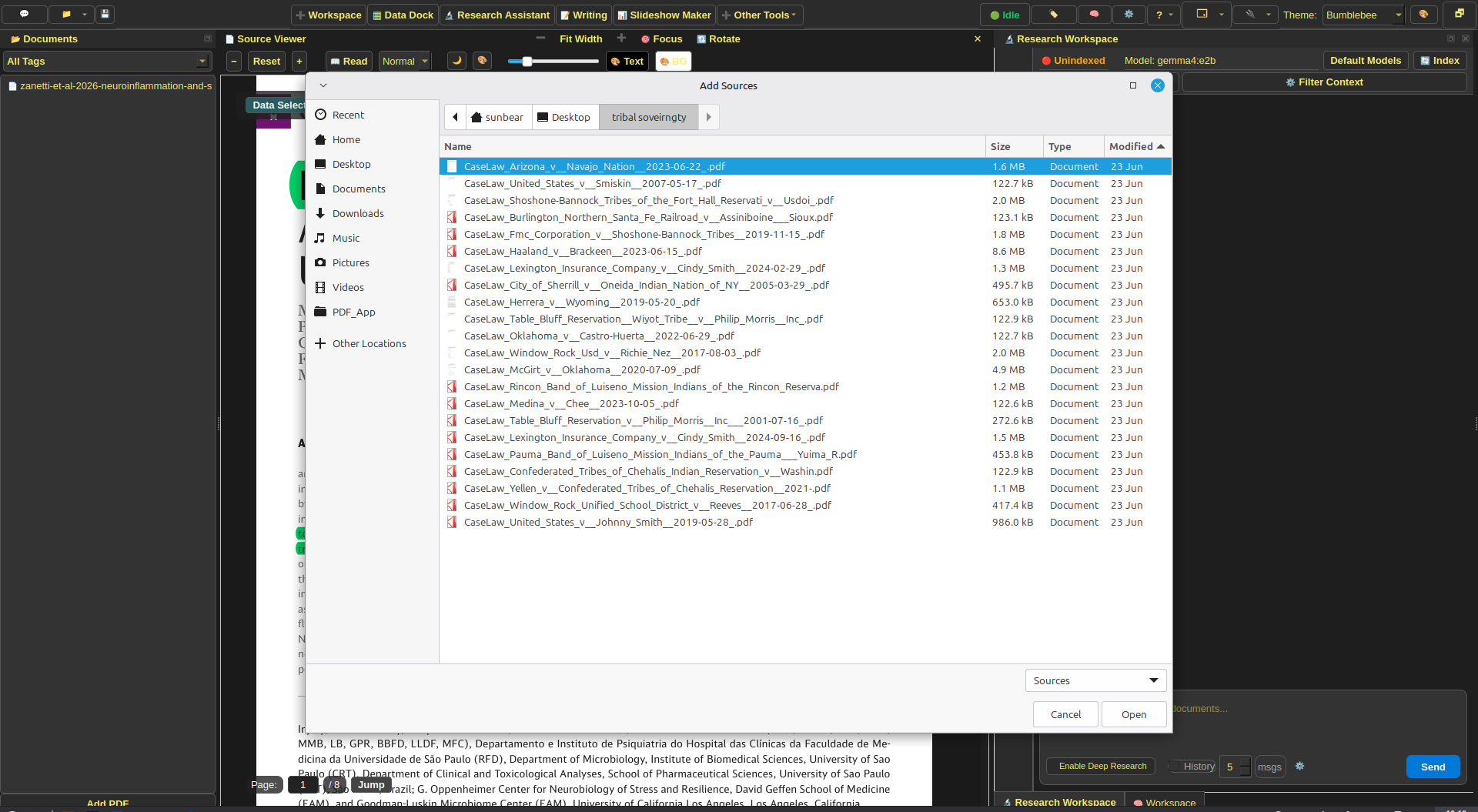
Figure 2. Sources are added to a local project before processing and review. - Annotate and organize evidenceHighlight passages, add notes and tags, and organize useful material in a visual workspace. The goal is to keep an interpretation attached to the passage that prompted it. All notes, workspace nodes, and highlights link directly back to the source material regardless of where they're interacted with.
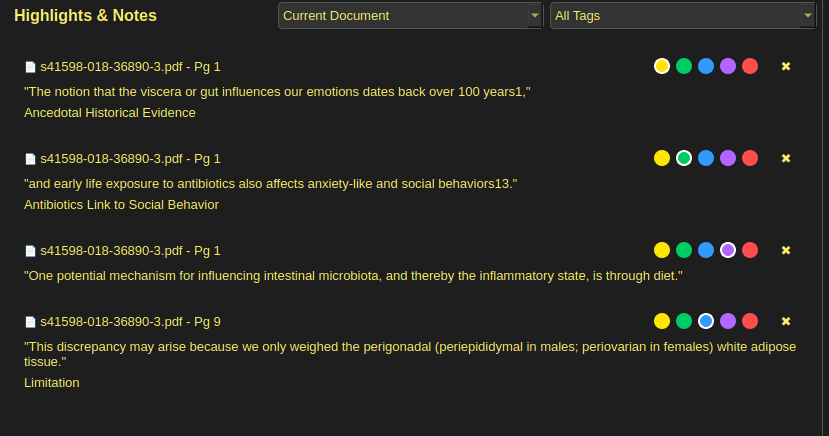
Figure 3. Note Dock showing a list of annotations taken on a source. - Explore connections and review assisted analysisSearch by wording or meaning (using semantic similarity on vector embeddings), run analysis templates to generate detailed graphs from sources, and inspect source-linked suggestions. Stored context and jump-to-source controls make checking possible, as extraction errors and misleading associations still remain possible, as all GenAI tools are prone to hallucinations.
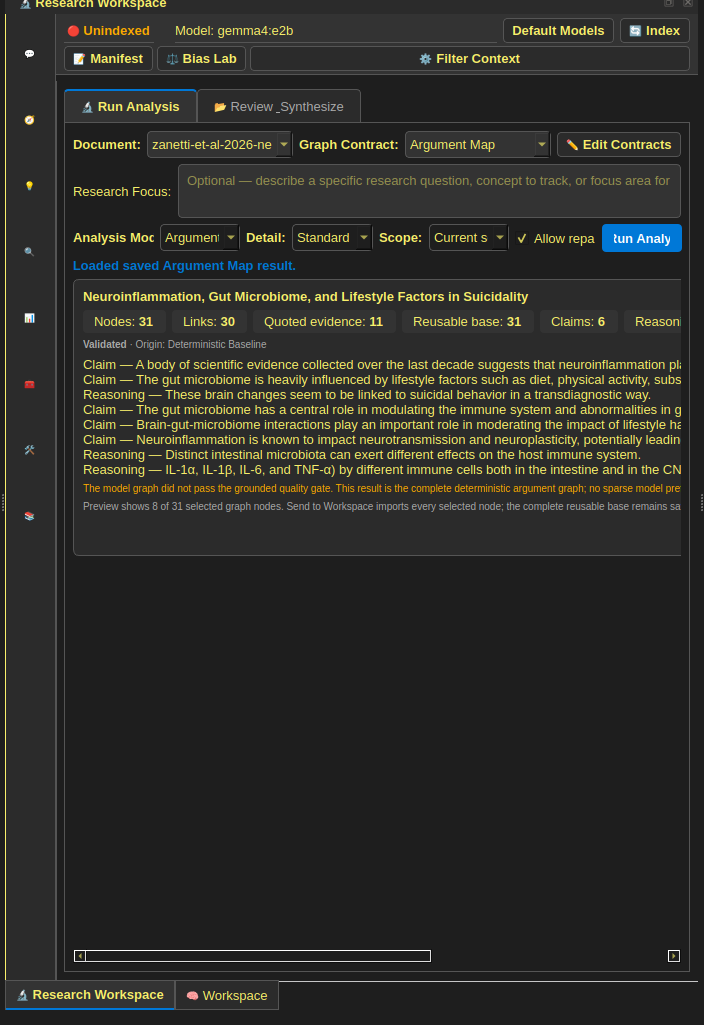
Figure 4. Analysis mode uses deterministic methods, in combination with smaller models and a final GenAI pass to generate a detailed graph, such as an argument map, from a source. These graphs can be added directly to workspace. - Write with traceable referencesPapyrus contains a built-in writing editor to help you turn your notes into a final paper. Using the citation dock, you can easily copy in-text citations and a works-cited page for individual notes and sources. No GenAI tools will write for you; they exist only to help find and organize information.
Continue through the project
The About page explains why I started the project. Features follows research tasks. Design Principles covers concerns and tradeoffs, while How Processing Works provides the technical path from import to retrieval and model use. Status & Limitations separates prototype descriptions from incomplete work and unresolved questions.